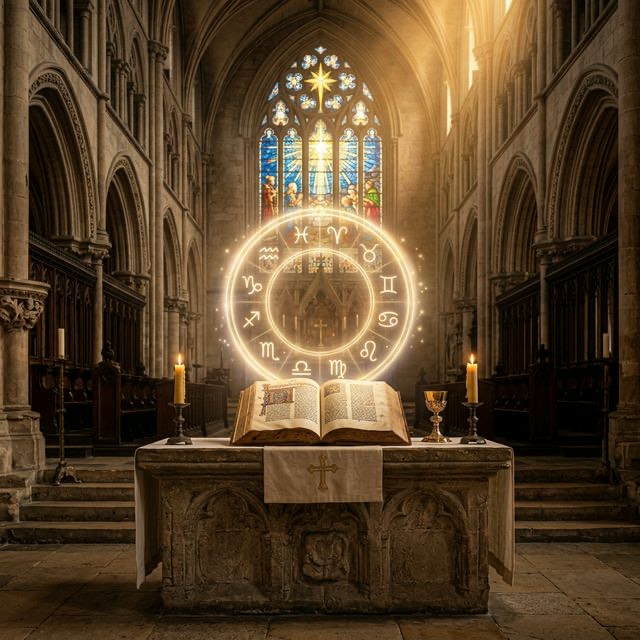
The relationship between astrology and Christianity is one of the most debated, misunderstood, and surprisingly intricate intersections in the history of religion.
On the surface, institutional Christianity has, for centuries, positioned itself in firm opposition to astrology. Passages such as Deuteronomy 18:10–12 and Isaiah 47:13–14 are frequently cited as divine prohibitions against consulting the stars. And yet, paradoxically, the foundational narrative of Christianity itself begins with an act of celestial interpretation: the Magi—ancient astrologers from the East—following a star to the birthplace of Jesus Christ.
This is not a simple contradiction. It is a gateway to a profound exploration. The Bible is saturated with star language, numerical patterns mirroring the zodiac, and cosmological symbolism that suggests a far more nuanced relationship between the Christian faith and the heavens than many realize.
Let us trace the celestial thread woven through Scripture and examine the evidence.
The Magi: When Astrologers Found God
The account of the Nativity in the Gospel of Matthew (2:1–12) is perhaps the most direct intersection of astrology and Christian Scripture. The "Magi" (from the Greek Magoi) were not simply "wise men" in a vague, generic sense. They belonged to a specific Persian priestly caste renowned for their mastery of astronomy, mathematics, dream interpretation, and—crucially—stellar divination.
In the ancient world, there was virtually no distinction between astronomy (the observation of stars) and astrology (the interpretation of their meaning). The Magi were, by every historical definition, astrologers. And it was precisely their expertise in reading the heavens that led them to the manger in Bethlehem.
What did they see? Scholars have proposed several astronomical theories for the "Star of Bethlehem":
- A rare triple conjunction of Jupiter and Saturn in the constellation of Pisces, which occurred in 7 BCE—a profoundly significant alignment in ancient astrological systems, as Jupiter symbolized kingship and Saturn was associated with the people of Israel.
- A bright comet recorded by Chinese astronomers around 5 BCE.
- A supernova, a stellar explosion that would have appeared as a brilliant "new star."
Regardless of the precise phenomenon, the theological implication is staggering: God chose to announce the birth of the Messiah not through a prophet, a dream, or an angel sent to the Jewish establishment, but through a celestial sign that could only be correctly interpreted by pagan astrologers. The very first people to recognize the Christ were practitioners of the art that later Christianity would condemn.
The Sacred Number 12: Tribes, Apostles, and the Zodiac
Perhaps the most structurally significant number in the entire Bible is the number 12. Its persistent recurrence is extraordinary:
- 12 sons of Jacob, who became the 12 tribes of Israel.
- 12 Apostles chosen by Jesus.
- 12 gates and 12 foundations of the New Jerusalem described in Revelation 21.
- 12 stars crowning the head of the celestial Woman in Revelation 12:1.
- 12 loaves of showbread placed in the Tabernacle.
- 12 precious stones on the High Priest's breastplate (Exodus 28:17–20), one for each tribe.
The zodiac, of course, consists of exactly 12 signs, mapped to the 12 months of the solar year. This is not a coincidence of convenience. The ancient world, including the civilization that produced the Hebrew Bible, operated on a base-12 (duodecimal) mathematical system precisely because it mirrored the observed 12-month cycle of the Moon and the 12 major constellations through which the Sun transited annually.
The question is not whether the number 12 in the Bible corresponds to the 12 signs of the zodiac. The question is: did the authors intend it to?
Jacob's Blessings and the Zodiac: Genesis 49
One of the most compelling pieces of evidence linking the tribes to the zodiac is found in Genesis 49, where the patriarch Jacob blesses his twelve sons on his deathbed. The imagery he uses is strikingly, almost suspiciously, aligned with zodiacal symbolism:
| Tribe | Jacob's Symbol | Proposed Zodiac Sign |
|---|---|---|
| Reuben | "Unstable as water" | Aquarius (the Water Bearer) |
| Simeon & Levi | "Instruments of cruelty" (paired) | Gemini (the Twins) |
| Judah | "A lion's whelp" | Leo (the Lion) |
| Zebulun | "Haven of the sea" | Pisces (the Fish) |
| Issachar | "A strong donkey" | Taurus (the Bull) |
| Dan | "A serpent by the way" | Scorpio (the Scorpion/Serpent) |
| Naphtali | "A deer let loose" | Capricorn |
| Joseph | "A fruitful bough" | Sagittarius (the Archer) |
| Benjamin | "A ravenous wolf" | Aries (the Ram) |
While scholars debate the precision of these correlations, the sheer density of animal and elemental imagery in a passage about exactly twelve sons is difficult to dismiss entirely as coincidence.
The Four Living Creatures: Ezekiel's Cherubim and the Fixed Signs
In both the book of Ezekiel (1:10) and the book of Revelation (4:7), four extraordinary "living creatures" are described with four distinct faces:
- The Lion
- The Ox (Bull)
- The Man (Human Face)
- The Eagle
In astrological tradition, these four symbols correspond precisely to the four "Fixed Signs" of the zodiac—the signs that mark the midpoint of each season and are considered the most powerful and stable:
- Leo — The Lion (Fixed Fire)
- Taurus — The Bull (Fixed Earth)
- Aquarius — The Man/Water Bearer (Fixed Air)
- Scorpio — The Eagle (Fixed Water; in ancient astrology, the higher octave of Scorpio was symbolized by the Eagle, representing transformation)
These four signs form the "Grand Cross" of the zodiac, dividing the celestial wheel into four equal quadrants. In the book of Numbers (chapter 2), the twelve tribes of Israel were commanded to encamp around the Tabernacle in four groups of three, with each group positioned under one of four primary tribal banners. According to Jewish tradition (the Midrash Rabbah), these four lead banners bore the symbols of a Lion (Judah, East), a Man (Reuben, South), an Ox (Ephraim, West), and an Eagle (Dan, North).
The correspondence is virtually exact. The arrangement of the Israelite camp, the faces of the Cherubim, and the four fixed zodiacal signs form a unified cosmological pattern.
The Number 7: Completeness and Cosmic Cycles
If 12 represents divine totality, 7 represents divine completeness and perfection in the Bible:
- 7 days of Creation.
- 7 seals, 7 trumpets, and 7 bowls of wrath in Revelation.
- 7 churches addressed in the opening of Revelation.
- 7 years of plenty and 7 years of famine in Joseph's Egypt.
In ancient astronomy, 7 was the number of visible celestial bodies that moved against the backdrop of the fixed stars: the Sun, the Moon, Mercury, Venus, Mars, Jupiter, and Saturn. These seven classical "planets" (from the Greek planetes, meaning "wanderers") were the foundation of all ancient astrological systems. The seven days of the week are, to this day, named after them (Sunday for the Sun, Monday for the Moon, Saturday for Saturn, etc.).
The persistent biblical use of 7 as the number of completeness may thus carry an embedded cosmological layer: the cosmos, defined by its seven visible wanderers, is a complete and perfect system designed by a divine architect.
A Nuanced Conclusion: Reading Heaven's Language
It would be intellectually dishonest to claim that the Bible "endorses" astrology in the modern, horoscope-reading sense. The Scriptures clearly warn against idolizing celestial bodies or using them to bypass direct relationship with God.
However, it would be equally dishonest to claim that the Bible exists in a vacuum, free from the rich, sophisticated astronomical and cosmological symbolism of the ancient Near East. The evidence is overwhelming: the number 12, the imagery of Jacob's blessings, the four living creatures, the significance of 7, and the astronomically literate Magi all point to a worldview in which the heavens were understood as a divinely authored text—a "second scripture" written in light, geometry, and planetary motion.
As the Psalmist wrote in Psalm 19:1: "The heavens declare the glory of God; the skies proclaim the work of His hands."
Perhaps the stars were never meant to be worshipped. Perhaps they were always meant to be read.