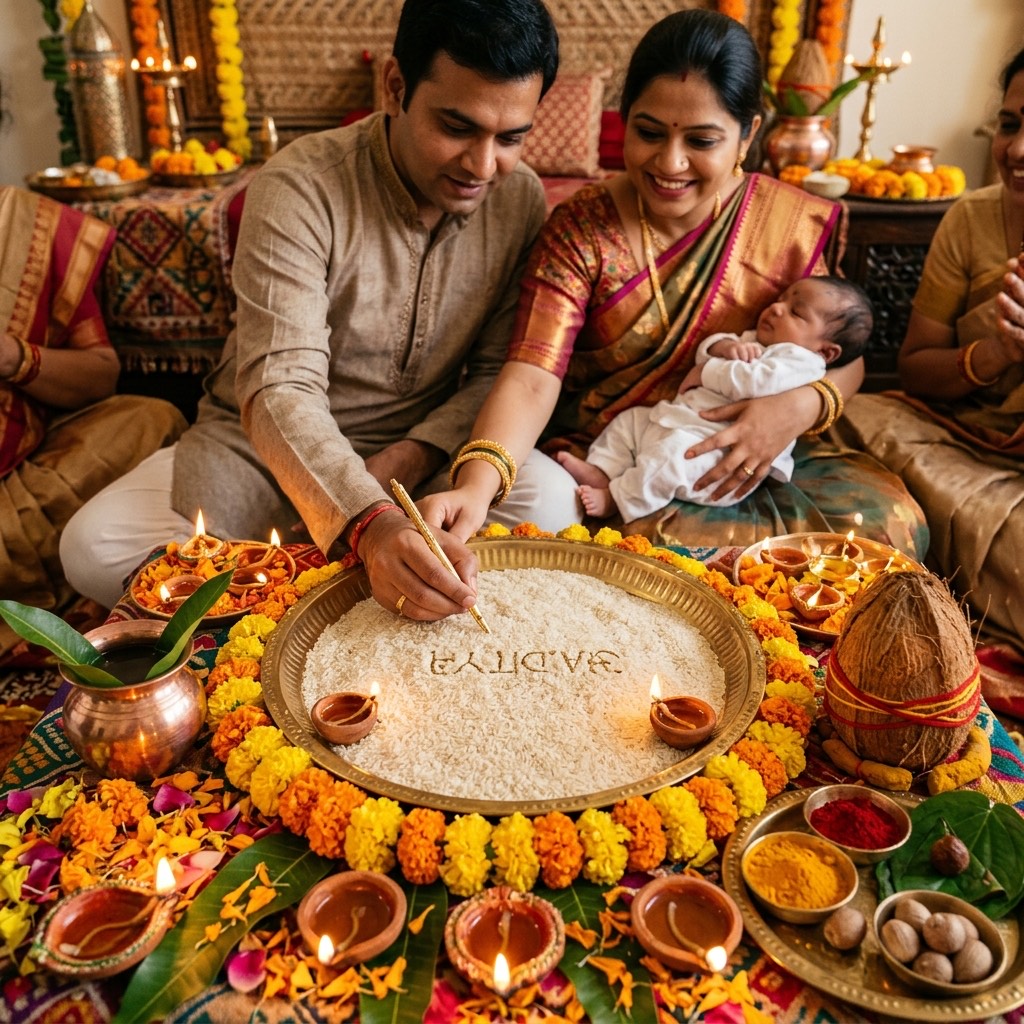
In the weeks following the birth of a child, every culture has some form of naming ritual. But few are as structured or spiritually rich as the Hindu Namakarana.
The Namakarana is a sacred Samskara — one of the sixteen foundational rituals marking the major transitions of a Hindu's life. The child is formally introduced to the universe, given an identity that harmonizes with cosmic forces, and showered with blessings.
The Significance of Namakarana
The word comes from two Sanskrit roots: Nama (name) and Karana (to make). It means "the creation of a name." The deeper significance includes:
- Identity Formation: In Vedic philosophy, a name is a mantra. Every time someone speaks your name, they invoke a specific vibrational pattern. The Namakarana ensures this pattern is aligned with the child's Nakshatra.
- Social Integration: The ceremony formally introduces the child to the extended family and community as a named individual.
- Divine Protection: The rituals invoke blessings of Agni (fire god), Ganesha (remover of obstacles), the child's Nakshatra deity, and family ancestors.
- Karmic Initialization: A well-chosen name, aligned with the birth chart, is said to support the child's dharma (life purpose).
When Is the Namakarana Performed?
- 11th or 12th day after birth: The most common traditional timing, after the initial Sutaka period ends.
- On a specific Muhurtham: Many families consult an astrologer for an auspicious date and time.
- Practical considerations: In modern practice, the ceremony may be postponed to the 3rd week, 40th day, or even months after birth. Mother and child's health always takes priority.
The Rituals: Step by Step
1. Purification and Preparation
The home is thoroughly cleaned. A sacred space is prepared with fresh flowers (marigolds, jasmine), oil lamps (diyas), incense, and a small fire pit (havan kund).
2. Ganapati Puja
The ceremony begins with prayers to Lord Ganesha, the remover of obstacles.
3. Havan (Fire Ritual)
A sacred fire is lit with offerings of ghee, grains, and herbs while Vedic mantras are chanted. The fire represents Agni, the divine witness.
4. The Naming Moment
The father leans close to the baby's right ear and whispers the chosen name three or four times. In many traditions, the father first uses a golden rod to write the name in a plate of uncooked rice grains — symbolizing inscription of the name into the child's destiny.
5. Blessings and Announcement
The name is announced to family and friends. Elders bless the child by placing grains of rice or flowers on the baby's head. Gifts are given and sweets distributed.
6. Horoscope Presentation
The astrologer who prepared the child's Jaathakam formally presents it, explaining the Nakshatra, Rashi, and astrological significance of the chosen name.
Regional Variations
- Kerala: Often incorporates a rice-feeding element. The maternal uncle may play a central role in Nair and Ezhava communities.
- Tamil Nadu: Known as "Thottil Ceremony" in some communities, coinciding with the cradle ceremony where the baby is placed in a decorated swing.
- North India: Often simpler, with Havan and ear-whispering as the primary rituals. The paternal grandmother may have a specific role.
- Bengal: Bengali families often combine naming with other early childhood Samskaras.
Five Types of Names in Vedic Tradition
According to classical texts, a child may receive up to five names:
- Nakshatra Nama — based on the birth star
- Masa Nama — based on the month of birth
- Devata Nama — the name of the family deity
- Rashi Nama — based on the zodiac sign
- Vyavaharika Nama — the everyday worldly name
Planning a Namakarana in 2026
Practical checklist:
- Calculate the baby's Nakshatra using exact birth time, date, and place. Use EJaathakam's free Jaathakam tool.
- Find an auspicious date with the Muhurtham finder.
- Determine the starting syllable and shortlist names.
- Use the Baby Name Suggester at ejaathakam.in/baby-names for curated options.
- Invite the extended family and arrange puja materials.
- Document the moment — hire a photographer or assign a family member to capture the naming.
A Name That Echoes Through a Lifetime
The Namakarana is a statement of faith — faith that the cosmos has a design, that your child has a place within it, and that a thoughtfully chosen name is a lifelong anchor to their spiritual heritage.
In a world of infinite choices, the Namakarana narrows the question to its essence: What name will best serve this soul on its journey?