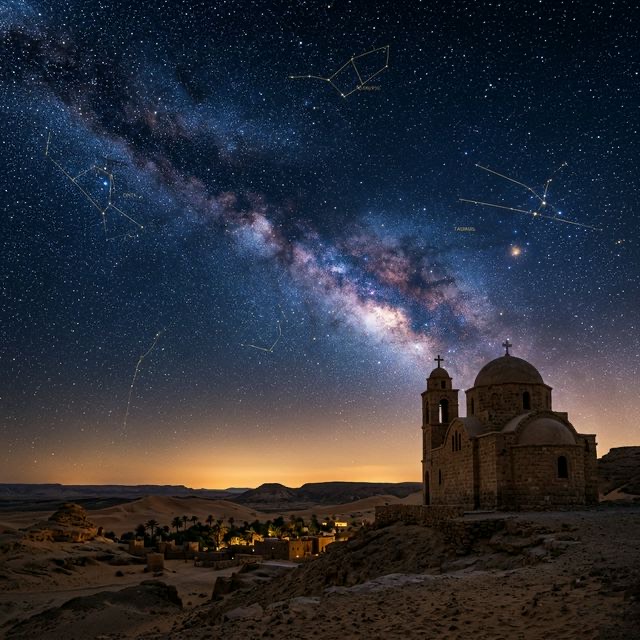
God asked Job: "Can you lead out Mazzaroth in its season?" What is the Mazzaroth, and could the ancient constellations contain a divinely authored message that predates Scripture itself? This in-depth guide explores the theory, the evidence, and the caution.
In the book of Job, chapter 38, verse 32, God issues a thundering challenge from the whirlwind: "Can you lead out Mazzaroth in its season, or can you guide the Great Bear with its cubs?"
This single, enigmatic verse contains one of the most debated words in all of Scripture: Mazzaroth. While the precise meaning has been discussed by scholars for centuries, the majority agree it refers to the constellations of the zodiac—the twelve major star groups through which the Sun appears to travel across the sky each year.
This raises a profound and controversial question: If God Himself referenced the zodiac in His dialogue with Job, could the constellations be more than just random patterns of light? Could they contain a divinely authored narrative—a "Gospel in the Stars" written in the night sky long before a single word of the Bible was penned?
The Theory: A Pre-Scriptural Revelation
The "Gospel in the Stars" theory was made famous in the 19th century by scholars such as Joseph A. Seiss (author of The Gospel in the Stars, 1882) and E. W. Bullinger (author of The Witness of the Stars, 1893). Their core argument is as follows:
- God Named the Stars: Psalm 147:4 states, "He determines the number of the stars; He calls them each by name." Isaiah 40:26 also references God calling the stars by name.
- Original Meanings Were Redemptive: The theory proposes that the original, God-given names and meanings of the 12 major constellations told the story of the Gospel—of a promised Redeemer, His struggle with evil, and His ultimate triumph.
- Distortion by Paganism: Over millennia, these pure meanings were corrupted by Babylonian, Egyptian, and Greek cultures into the pagan practice of astrology, which sought to use the stars for personal divination rather than reading them as a testimony of God's plan.
The Proposed Zodiac Gospel
Proponents map the 12 constellations to specific stages of the redemption narrative:
| Constellation | Proposed Gospel Meaning |
|---|---|
| Virgo (The Virgin) | The promised Seed of the Woman (Genesis 3:15) |
| Libra (The Scales) | The price of redemption; divine justice |
| Scorpio (The Scorpion) | The conflict between the Seed and the Serpent |
| Sagittarius (The Archer) | The Conqueror going forth to triumph |
| Capricorn (The Goat-Fish) | The sacrifice of atonement |
| Aquarius (The Water Bearer) | The outpouring of living water (the Holy Spirit) |
| Pisces (The Fish) | The people of God bound but blessed |
| Aries (The Ram) | The Lamb of God, slain and risen |
| Taurus (The Bull) | The coming Judge in glory |
| Gemini (The Twins) | The dual nature of the Redeemer (human and divine) |
| Cancer (The Crab/Fold) | The gathering of the redeemed |
| Leo (The Lion) | The Lion of Judah, the final triumph |
In this framework, the zodiac begins with Virgo (the Virgin birth) and concludes with Leo (the Lion of the tribe of Judah triumphing)—a complete narrative arc from prophecy to fulfillment.
Biblical Support and Key Scriptures
Advocates of the theory lean heavily on several key passages:
- Psalm 19:1–4: "The heavens declare the glory of God; the skies proclaim the work of His hands. Day after day they pour forth speech; night after night they reveal knowledge. They have no speech, they use no words; no sound is heard from them. Yet their voice goes out into all the earth, their words to the ends of the world." Proponents argue that this "speech" without words is the visual, symbolic Gospel story laid out in the constellations.
- Romans 10:18: Paul, quoting Psalm 19, writes: "But I ask: Did they not hear? Of course they did: Their voice has gone out into all the earth, their words to the ends of the world." Some scholars argue Paul was affirming that the Gospel testimony in the stars preceded the written Word and reached all nations.
- Job 38:31–33: God's direct reference to the Mazzaroth, Pleiades, and Orion as systems He personally controls, establishing His authority over the cosmic order.
The Theological Caution
While the theory is fascinating, it is important to understand why mainstream biblical scholars and most Christian denominations urge significant caution:
- The Bible Never Explicitly Teaches It. If the constellations contained a core Gospel message, it would be a foundational doctrine—yet no chapter in Scripture walks the reader through this "star gospel." The theory relies entirely on inference and symbolic interpretation.
- Confirmation Bias Risk. Critics argue that the constellation-to-Gospel mapping is often reverse-engineered: believers already know the Gospel story and read it into the star names, rather than the star names independently revealing the story.
- Danger of Blending with Astrology. The greatest concern is that the theory can be used as a gateway to legitimize astrological practices. If the zodiac is viewed as divinely authored, believers may be tempted to take the next step and consult their birth sign for guidance—a practice Scripture explicitly forbids.
A Balanced View: Wonder Without Worship
The safest and most theologically grounded approach is one of awe without idolatry. Christians can marvel at the breathtaking structure of the cosmos, study the Mazzaroth as a testimony to God's creative power, and appreciate the intriguing symbolic parallels—without crossing the line into consulting the stars for personal guidance.
As Psalm 19:1 declares, the heavens declare God's glory. They point upward, toward their Creator. They are not the message themselves; they are the billboard advertising the Author.
Whether or not the constellations were originally named by God to tell the Gospel story remains an open question. But one truth is clear: every star, every planet, and every constellation exists because an omnipotent Creator spoke them into being—and that alone is worthy of reverent wonder.