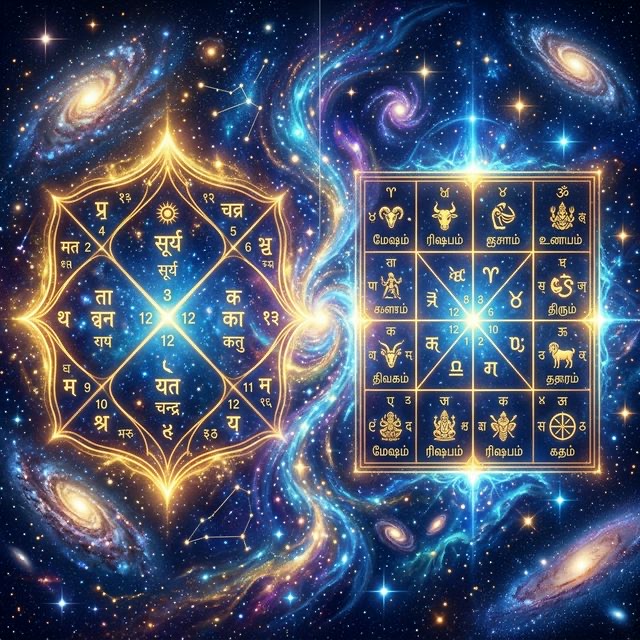
If you have ever tried to generate your birth chart online, you have almost certainly hit a fork in the digital road: Do you want a North Indian chart or a South Indian chart?
For beginners, this choice can be incredibly confusing. It often leads to the mistaken belief that one system is inherently "better," "more accurate," or entirely distinct from the other. Is a North Indian Kundali superior to a South Indian Jaathakam? If you were born in Delhi but use a South Indian chart, are your horoscope predictions going to be entirely wrong?
Let’s definitively decode the "North vs. South" debate in Vedic astrology and help you choose the visual map that works best for you.
The Big Secret: They Are Exactly the Same
Here is the most important truth regarding the North vs. South debate: The underlying astronomical math is 100% identical.
Vedic astrology (Jyotish) is an ancient science that calculates the exact position of the planets and constellations at the precise moment and geographical coordinates of your birth. If Mars was transiting through the constellation of Aries on the day you were born, the mathematics of Jyotish recognize this fact universally.
Whether you call it a Kundli (the common term used in Northern India) or a Jaathakam (the term used in the South), the data feeding into the chart does not change. Your Ascendant, your Moon sign, and your planetary "Doshas" remain a constant truth.
The only difference between a North Indian Kundli and a South Indian Jaathakam is how that identical data is drawn on a piece of paper. They are simply two different styles of packaging the exact same cosmic gift.
The North Indian Kundli: The Diamond Grid
The North Indian chart is incredibly distinct. It consists of a large, complex geometric pattern of overlapping squares that create four large diamonds in the center, flanked by eight triangles.
Why Use It?
The primary logic of the North Indian Kundli is that it is House-Centric.
- The large diamond fixed directly at the top center of the page always represents the 1st House (your Ascendant).
- Because the physical houses never move on the paper, the Zodiac signs (Aries through Pisces) must "shift" through the fixed houses depending on your time of birth.
- The chart is read in an anti-clockwise direction.
The Advantage: This style places immense emphasis on the "Kendras." The Kendras are the angular houses—the 1st (self), 4th (home), 7th (partnership), and 10th (career). Because these four houses form the large central cross of the chart, an astrologer can instantly evaluate the core foundational pillars of a person’s life at a mere glance.
The South Indian Jaathakam: The Sky Map
In stark visual contrast, the South Indian chart abandons the diamonds entirely. It uses a very clean, simple perimeter grid consisting of 12 outer squares surrounding a blank middle space.
Why Use It?
The logic of the South Indian Jaathakam is that it is Sign-Centric.
- The square located in the second position from the top-left always represents Aries. The box below it is always Taurus, and so forth. The Zodiac wheel never moves on the paper.
- Because the signs are fixed in place, the Houses must "shift." The astrologer calculates your Ascendant and marks two diagonal lines in the corresponding Zodiac box. That box is now your 1st House.
- The chart is read in a clockwise direction.
The Advantage: This style acts as a literal, static map of the sky. Because the Zodiac signs act as a permanent background, it is extraordinarily easy to visualize the real-time movement of planets (Transits or Gocharas) moving through the sky and interacting with your birth placements.
Which One Should You Choose?
The choice between generating a North Indian Kundli or a South Indian Jaathakam ultimately comes down to two factors: cultural familiarity and personal visual preference.
If you are consulting a traditional astrologer in Varanasi, displaying a South Indian grid will force them to mentally translate the geometry. If you are learning astrology from southern texts, a North Indian chart will be highly confusing to read.
However, if you are simply an enthusiast looking to delve into your own personal cosmos, choose the chart that your brain finds easiest to visually navigate! Do you prefer the immediate focus on the core "Houses" of the North? Or do you prefer the logical, sky-map layout of the South?