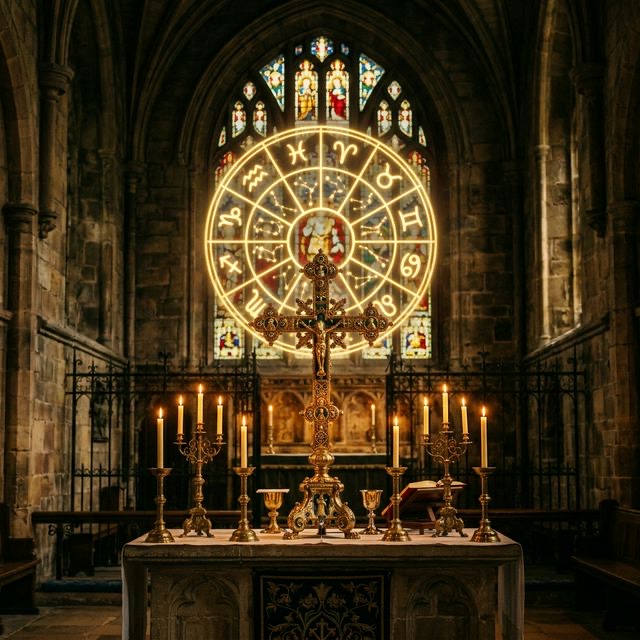
Walk into almost any Indian household during wedding season—whether Hindu, Muslim, or Christian—and you will encounter the same sacred question: "Have you checked the Jaathakam?"
In India, the birth chart (Jaathakam, Kundali, or Koshthi) is not merely a spiritual curiosity. It is a deeply embedded cultural institution that transcends religious boundaries. Families use it to determine auspicious wedding dates, to match the temperaments and destinies of prospective brides and grooms, to choose names, and even to select the right time to start a new business.
For the estimated 28 million Christians in India, this cultural reality creates a profound and deeply personal tension. The Bible warns against consulting the stars. But your grandmother, your family priest, and your cultural heritage may all expect you to produce a Jaathakam before anyone will seriously discuss a marriage proposal.
So how does a faithful Indian Christian navigate this minefield?
Understanding the Cultural Context
It is crucial to first understand why the Jaathakam is so deeply embedded in Indian life, irrespective of religion.
The practice of Jyotish (Vedic astrology) is over 5,000 years old. It predates Christianity's arrival in India by millennia. When the Apostle Thomas is believed to have brought the faith to Kerala around 52 AD, he arrived in a civilization where the reading of celestial movements was already a deeply established technology of daily life.
Over the centuries, Indian Christians—particularly the ancient Syrian Christian communities of Kerala (Nasrani), the Goan Catholics, and the Tamil Christians—adopted many cultural practices that were not strictly "religious" in a Hindu sense but were rather integral aspects of Indian social infrastructure. The Jaathakam became one of these practices.
For many Indian Christian families today, checking the birth chart is not an act of worshipping the planets. It is understood as a practical, cultural due-diligence step—similar to a background check or a personality assessment—embedded in the social fabric of marriage.
What Does the Bible Actually Say?
The biblical position on astrology is clear and consistent:
- Deuteronomy 18:10–12 prohibits divination, fortune-telling, and consulting omens.
- Isaiah 47:13–14 mocks the Babylonian stargazers, declaring their inability to save themselves.
- Jeremiah 10:2 cautions: "Do not learn the way of the nations or be terrified by the signs of the heavens."
However, the Bible also acknowledges the heavens as God's creation and a testimony to His glory (Psalm 19:1, Genesis 1:14). The critical distinction is between observing God's handiwork (permitted) and seeking guidance or predictions from created objects (forbidden).
Three Common Positions Among Indian Christians
In practice, Indian Christians tend to fall into one of three camps:
1. Complete Rejection
Some Christians, particularly those from Evangelical and Pentecostal traditions, reject the Jaathakam entirely. They view any engagement with birth charts as a direct violation of Deuteronomy 18 and an expression of faith in created objects rather than the Creator. For these believers, trusting in the Jaathakam demonstrates a lack of trust in God's sovereignty over their future.
2. Cultural Acceptance with Caveats
A significant number of Christians—particularly within the older Syrian Christian, Catholic, and mainline Protestant traditions—accept the Jaathakam as a cultural formality without attributing spiritual power to it. They draw a careful line: they may check the chart out of respect for family elders and cultural tradition, but they do not believe the chart determines their destiny. Their faith in God's plan remains primary; the chart is secondary social protocol.
3. The "God's Design" Perspective
A smaller but growing group argues that Jyotish, at its deepest level, is not about worship but about mathematics—the geometric mapping of planetary positions at a specific time. They see the birth chart as a neutral data visualization, similar to DNA mapping or psychological profiling. In this view, God designed the cosmos with profound mathematical order, and a birth chart simply captures a snapshot of that divine mathematics. The chart does not predict fate; it describes the conditions under which a soul entered the world.
Navigating the Crossroads: Practical Guidance
For Indian Christians wrestling with this tension, here are some thoughtful principles:
Distinguish Between Culture and Worship. Participating in a cultural tradition is not the same as worshipping a false god. However, if the practice causes you to place more trust in the chart than in God's Word and the Holy Spirit, consider stepping back.
Examine Your Heart. Ask yourself honestly: "Am I checking this chart out of curiosity and cultural respect, or am I anxiously seeking answers about my future that I should be seeking from God?" The answer to that question matters profoundly.
Communicate with Your Family. If you feel convicted that you cannot participate in Jaathakam-related practices, communicate this conviction to your family with gentleness and respect (1 Peter 3:15–16). Cultural change within families takes time and patience, not confrontation.
Prioritize Scripture. Regardless of your cultural engagement with birth charts, let the Bible remain your ultimate source of truth, identity, and guidance. A chart may describe planetary geometry; only God's Word describes your purpose.
The Stars Declare, But God Decides
The night sky over India is the very same sky that Abraham, Moses, and the Apostle Thomas gazed upon. It is magnificent, ancient, and mathematically breathtaking. And yet, it is still just a canvas—pointing always to the Artist who painted it.
For Indian Christians, navigating the world of the Jaathakam is not about finding the "right answer" to a simple yes-or-no question. It is about the far deeper, far more personal journey of discerning where cultural tradition ends and spiritual conviction begins—and having the courage to walk that line with faith, humility, and grace.